Insect life graces planted prairies, even at this time of year -- hiding in stems (and other places), waiting for warmth to return.
My friend and collaborator MJ Hatfield recently issued an invitation to Iowa naturalist-types: Would you be interested in investigating the insect life in a planted prairie near you?
Part of my insect natural history work in the last couple of years has involved hunting for bugs in prairie -- but I usually search remnant prairies, those few rocky slopes and soggy fields from which native prairie plants were never evicted. I am fascinated by the question of what little-known insects might persist in these remnants, living out their lives in age-old relationship with their now-scarce host plants.
It's been an interesting path of discovery, and I intend to continue it...AND MJ's invitation was also just too good for me to turn down. Her insect natural history studies have for years included both remnant and planted (or reconstructed) prairies, mostly in Iowa and Minnesota -- and her work in reconstructions has shown clearly that these places do harbor native insects, including specialists that require native prairie plants for their survival. Research led by Kirk Larsen at Luther College is another local example of work that's shedding light on the insect life in northeastern Iowa's planted prairies.
At the same time, there's a lot still to learn. While reconstructed prairies are becoming more and more common -- consider Decorah's own Anderson Prairie and Community Prairie -- our understanding of their insect fauna, generally speaking, is quite poor. In most cases we know very little about how this whole prairie reconstruction thing is working out for native insects. So it's a good thing that MJ's invitation garnered at least ten "yes!" responses. As each of us respondees hunts bugs in a planted prairie near us -- which we will be doing without pay, on our own time, mind you -- we'll share what we find with one another and on Bugguide, and hopefully in other outlets too. In this post, I'll be sharing my findings from a recent walk at Decorah's Community Prairie.
---
It was a dreary afternoon for a walk through the Community Prairie. A thaw was on, and moisture hung thickly in the still air -- but it was a cold sort of wet, clammy and dank. I dressed in many layers.
First item of business: checking the dead stems (or culms) of big bluestem for a little yellow grub. Last winter I found these "grubs" -- the larvae of a delightful, iridescent green, long-legged fly -- waiting out the cold in tunnels they'd drilled (with their mouthparts!) through big bluestem culms in a nearby remnant prairie. They belong to a genus known scientifically as Thrypticus. With various other larvae of moths, beetles, flies, sawflies, and more, Thrypticus in turn belongs to the informal and surprisingly diverse clan of stem borers -- animals that feed on the whitish, spongy pith inside stems of herbaceous plants.
As it happened, some dead culms of big bluestem stood at attention right beside the wooden Community Prairie entrance sign. The first one I cut open had nothing inside. But the second culm had been tunnelled...

...and it was a good thing I cut it off at ground level, because there, inside the very base of the culm, dwelled my quarry. Here is is, posed on the tip of my index finger.

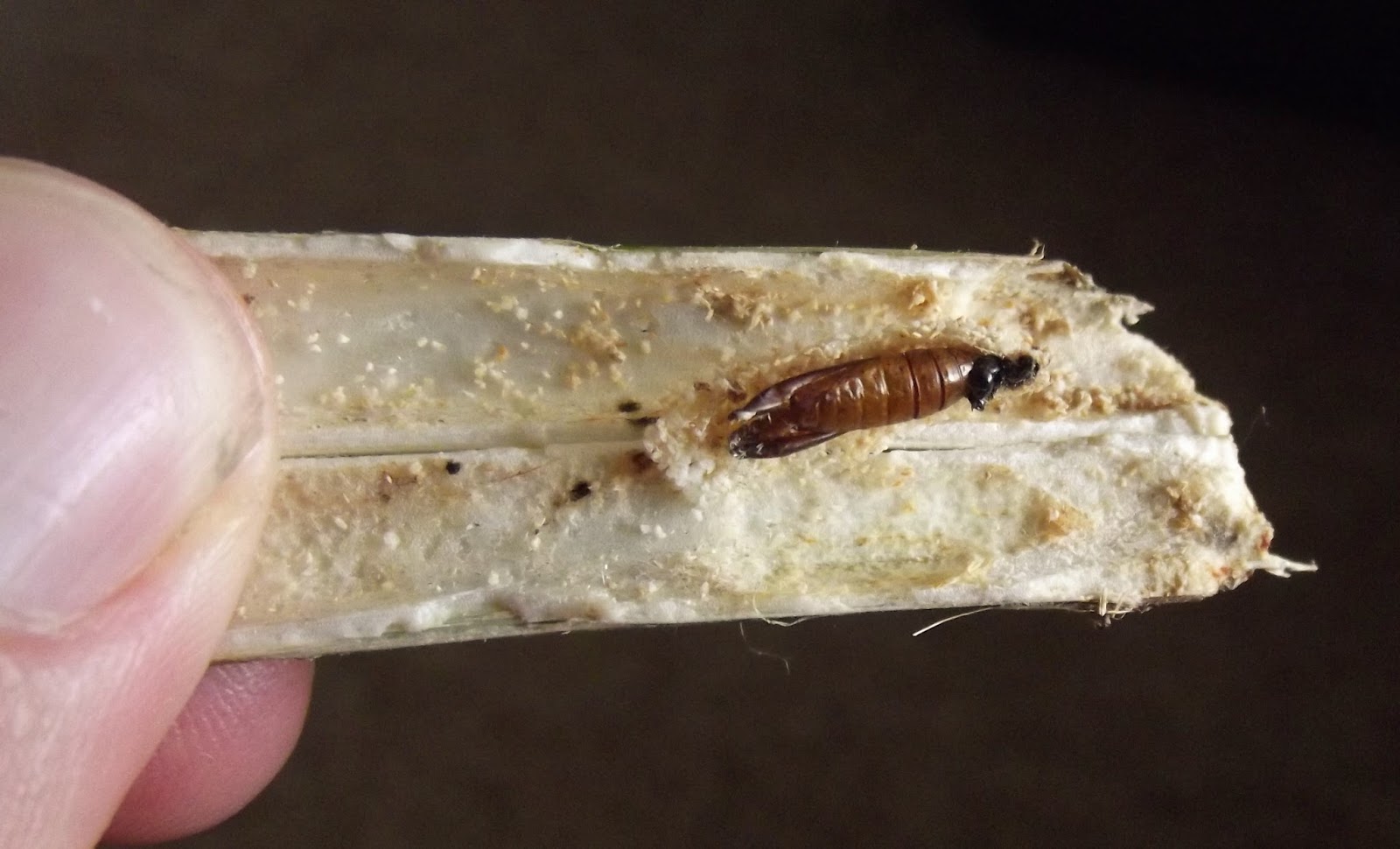
In the spring this animal pupates inside the dead grass culm and soon thereafter emerges as an adult fly:

Isn't she lovely? In spring 2017 this female came out of one of those big bluestem culms I gathered from the remnant prairie. Here is her pupal skin, still lodged in the culm whence she emerged:

Check out those spines!
You can see more images here (scroll down for clickable thumbnails). That Bugguide post grabbed the attention of some researchers at NYU who are studying eye development in flies -- and now Fleur, Claude, and I, along with Keith, an amateur entomologist in Illinois, have teamed up in an effort to better understand where to find these flies as larvae. (My recent finding of Thrypticus in culms of Virginia wild rye, Elymus virginicus, at Chattahoochie Park in Decorah adds to the local list of known host plants.)
Speaking of which...since Canada wild rye, Elymus canadensis, grows in abundance at the Community Prairie, I thought I'd check that for Thrypticus, too. In this grass I didn't find any little yellow grubs, sadly...but I did find a little whitish one:


This looks somewhat similar to a Thrypticus larva, but there are noticeable differences -- especially the mouthparts. You can clearly see this creature's two opposing mandibles in the second photo above; Thrypticus wouldn't have this. Our little whitish grub is probably a larval beetle or wasp -- and I'm leaning toward wasp, since I can't see any legs (Bugguide notes that "most [larvae of wasps and their relatives] are grub-like, lacking legs"). Its exact identity will likely remain a mystery until someone is able to rear it to adulthood.
Walking further into the prairie, I came upon seedheads of ironweed, Vernonia fasciculata. This tall composite adds rich hues of golden brown to the winter prairiescape.

One ironweed stem hosted a short row of closely-spaced holes:

This is where a female insect, probably a tree cricket, inserted her ovipositor in order to lay a series of eggs in the stem. When you break open an affected stem in such a place, you can see the eggs inside:

Follow this link for a rare and intimate portrait of a hatchling tree cricket in the process of emerging from its egg.
Next stop: Cup-plant! Also known as Silphium perfoliatum. There are patches of this plant scattered throughout the Community Prairie, their pale dead stems all splayed out:

And guess what? My eye caught a sign on this plant that you readers may recognize:


That's right...here, as in "A smart bunch, part 1" and part 2, an enterprising bird has been hunting and pecking (so to speak) for something overwintering inside the stem. Not sure what that "something" might be, I started breaking open stems to investigate. Right away, in another cup-plant stem other than the one shown above, I found an insect you may find familiar:

Little chambers in the pith, each with a grub inside...just as in wild lettuce:
The chamber-grubs in wild lettuce and in cup-plant are closely related. They are both gall wasps -- just different species, each one adapted to life in its particular host plant. Actually, I hear there are multiple species of gall wasp known from plants in the genus Silphium; here's MJ's Bugguide series showing adults she reared from this host.
Interestingly, although the wild lettuce gall wasps are clearly targeted by hungry birds, I didn't see any evidence that the cup-plant gall wasps at the Community Prairie are being similarly targeted. Instead, the birds seem to be looking for another quarry. That stem with the bird-holes I showed you a minute ago? It had a total of 14 such holes in it, spread out over quite a distance. The most thorough pecking seemed to be concentrated on a portion of stem that had been hollowed out by some kind of stem borer. Here, you can see the bird-holes, opening into the tunnel made by the mystery borer.

I should pause to say that not all hollow or hollow-ish cup-plant stems have been hollowed out by an insect. Cup-plant's winter stems seem to be variably solid by nature: some are filled with pith, others are mostly hollow...and this can vary even in different parts of a single stem. Here's a cross-section of a mostly hollow stem that's just naturally that way:

Distinguishing a "natural" hollow from a borer tunnel isn't always easy. In this case, I found that the borer tunnels could be identified by discoloration and especially by the presence of crumbly poop (frass):

Now cup-plant stems are pretty thick, and this tunnel is wide and crammed with LOTS of frass -- so I deduced that the borer must be pretty large (for a stem-dwelling insect). Of course, in this case the bird had found its prey, extricated it from its tunnel, and eaten it, so I was out of luck...but not for long. A neighboring stem was similarly tunneled, and the birds hadn't gotten to it yet -- and I was fortunate enough to open it up next, and find this inside:


How's THAT for a tasty bird-morsel?

Judging by the slightly swollen thorax, well-defined head, and lack of obvious prolegs, I think this is a beetle larva, but I'm not sure. Its color seems "off" to me, suspicious, like the larva might be unwell...so I'm not particularly optimistic about getting an adult. But I did reintroduce it to a cup plant stem and bring it home for rearing. We'll see what happens.
After finding this, I spent a while hunting other nearby patches of cup-plant for bird-holes and borer tunnels. In the end I found only three or four stems that had clearly been pecked up by birds, and I wasn't able to find any more intact stems with borer larvae still inside. So it's not clear to me how widespread the bird sign or the insect prey may be. However, you can bet I'll be watching the next patch of cup-plant I come across -- and I hope you do too!
On my way back to the car, as darkness arrived, I scored one last insect sighting:

This is a stem gall on indigo bush (Amorpha fruticosa), a native shrub. In past visits to the Community Prairie, I'd looked for this gall to no avail -- so I was surprised and pleased to find it this time. If you cut it open you would find a sizable larva overwintering inside -- a moth larva, specifically, belonging to the genus Walshia. You can also find similar galls on indigo bush's congener, leadplant (Amorpha canescens). As with most other larval insects found in stems at this time of year, Walshia caterpillars will pupate sometime in the spring and emerge as adults shortly thereafter.
Incidentally, the foliage of indigo bush can be easily confused with that of black locust, a thorny tree that has been attempting to establish itself in the Community Prairie. Volunteers have spent a lot of time removing locust from this site -- and they are to be commended for recognizing indigo bush as a different (and less aggressive) plant and letting it be.
All for now!
My friend and collaborator MJ Hatfield recently issued an invitation to Iowa naturalist-types: Would you be interested in investigating the insect life in a planted prairie near you?
Part of my insect natural history work in the last couple of years has involved hunting for bugs in prairie -- but I usually search remnant prairies, those few rocky slopes and soggy fields from which native prairie plants were never evicted. I am fascinated by the question of what little-known insects might persist in these remnants, living out their lives in age-old relationship with their now-scarce host plants.
It's been an interesting path of discovery, and I intend to continue it...AND MJ's invitation was also just too good for me to turn down. Her insect natural history studies have for years included both remnant and planted (or reconstructed) prairies, mostly in Iowa and Minnesota -- and her work in reconstructions has shown clearly that these places do harbor native insects, including specialists that require native prairie plants for their survival. Research led by Kirk Larsen at Luther College is another local example of work that's shedding light on the insect life in northeastern Iowa's planted prairies.
At the same time, there's a lot still to learn. While reconstructed prairies are becoming more and more common -- consider Decorah's own Anderson Prairie and Community Prairie -- our understanding of their insect fauna, generally speaking, is quite poor. In most cases we know very little about how this whole prairie reconstruction thing is working out for native insects. So it's a good thing that MJ's invitation garnered at least ten "yes!" responses. As each of us respondees hunts bugs in a planted prairie near us -- which we will be doing without pay, on our own time, mind you -- we'll share what we find with one another and on Bugguide, and hopefully in other outlets too. In this post, I'll be sharing my findings from a recent walk at Decorah's Community Prairie.
---
It was a dreary afternoon for a walk through the Community Prairie. A thaw was on, and moisture hung thickly in the still air -- but it was a cold sort of wet, clammy and dank. I dressed in many layers.
First item of business: checking the dead stems (or culms) of big bluestem for a little yellow grub. Last winter I found these "grubs" -- the larvae of a delightful, iridescent green, long-legged fly -- waiting out the cold in tunnels they'd drilled (with their mouthparts!) through big bluestem culms in a nearby remnant prairie. They belong to a genus known scientifically as Thrypticus. With various other larvae of moths, beetles, flies, sawflies, and more, Thrypticus in turn belongs to the informal and surprisingly diverse clan of stem borers -- animals that feed on the whitish, spongy pith inside stems of herbaceous plants.
As it happened, some dead culms of big bluestem stood at attention right beside the wooden Community Prairie entrance sign. The first one I cut open had nothing inside. But the second culm had been tunnelled...
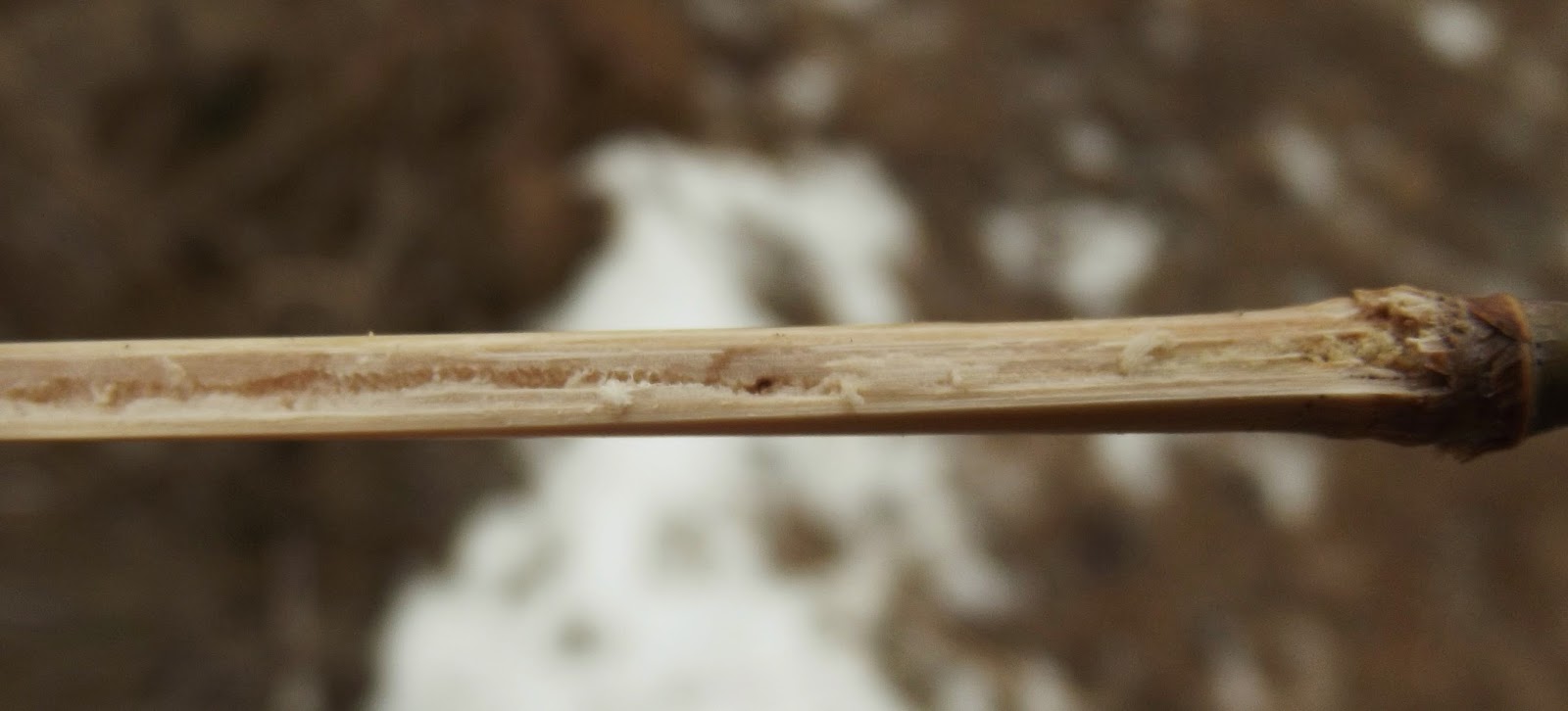
...and it was a good thing I cut it off at ground level, because there, inside the very base of the culm, dwelled my quarry. Here is is, posed on the tip of my index finger.

Isn't she lovely? In spring 2017 this female came out of one of those big bluestem culms I gathered from the remnant prairie. Here is her pupal skin, still lodged in the culm whence she emerged:
Check out those spines!
You can see more images here (scroll down for clickable thumbnails). That Bugguide post grabbed the attention of some researchers at NYU who are studying eye development in flies -- and now Fleur, Claude, and I, along with Keith, an amateur entomologist in Illinois, have teamed up in an effort to better understand where to find these flies as larvae. (My recent finding of Thrypticus in culms of Virginia wild rye, Elymus virginicus, at Chattahoochie Park in Decorah adds to the local list of known host plants.)
Speaking of which...since Canada wild rye, Elymus canadensis, grows in abundance at the Community Prairie, I thought I'd check that for Thrypticus, too. In this grass I didn't find any little yellow grubs, sadly...but I did find a little whitish one:


This looks somewhat similar to a Thrypticus larva, but there are noticeable differences -- especially the mouthparts. You can clearly see this creature's two opposing mandibles in the second photo above; Thrypticus wouldn't have this. Our little whitish grub is probably a larval beetle or wasp -- and I'm leaning toward wasp, since I can't see any legs (Bugguide notes that "most [larvae of wasps and their relatives] are grub-like, lacking legs"). Its exact identity will likely remain a mystery until someone is able to rear it to adulthood.
Walking further into the prairie, I came upon seedheads of ironweed, Vernonia fasciculata. This tall composite adds rich hues of golden brown to the winter prairiescape.

One ironweed stem hosted a short row of closely-spaced holes:


Follow this link for a rare and intimate portrait of a hatchling tree cricket in the process of emerging from its egg.
Next stop: Cup-plant! Also known as Silphium perfoliatum. There are patches of this plant scattered throughout the Community Prairie, their pale dead stems all splayed out:

And guess what? My eye caught a sign on this plant that you readers may recognize:


That's right...here, as in "A smart bunch, part 1" and part 2, an enterprising bird has been hunting and pecking (so to speak) for something overwintering inside the stem. Not sure what that "something" might be, I started breaking open stems to investigate. Right away, in another cup-plant stem other than the one shown above, I found an insect you may find familiar:

Little chambers in the pith, each with a grub inside...just as in wild lettuce:
 |
| Aulacidea sp. gall wasp in stem of Lactuca biennis, wild lettuce |
The chamber-grubs in wild lettuce and in cup-plant are closely related. They are both gall wasps -- just different species, each one adapted to life in its particular host plant. Actually, I hear there are multiple species of gall wasp known from plants in the genus Silphium; here's MJ's Bugguide series showing adults she reared from this host.
Interestingly, although the wild lettuce gall wasps are clearly targeted by hungry birds, I didn't see any evidence that the cup-plant gall wasps at the Community Prairie are being similarly targeted. Instead, the birds seem to be looking for another quarry. That stem with the bird-holes I showed you a minute ago? It had a total of 14 such holes in it, spread out over quite a distance. The most thorough pecking seemed to be concentrated on a portion of stem that had been hollowed out by some kind of stem borer. Here, you can see the bird-holes, opening into the tunnel made by the mystery borer.

I should pause to say that not all hollow or hollow-ish cup-plant stems have been hollowed out by an insect. Cup-plant's winter stems seem to be variably solid by nature: some are filled with pith, others are mostly hollow...and this can vary even in different parts of a single stem. Here's a cross-section of a mostly hollow stem that's just naturally that way:
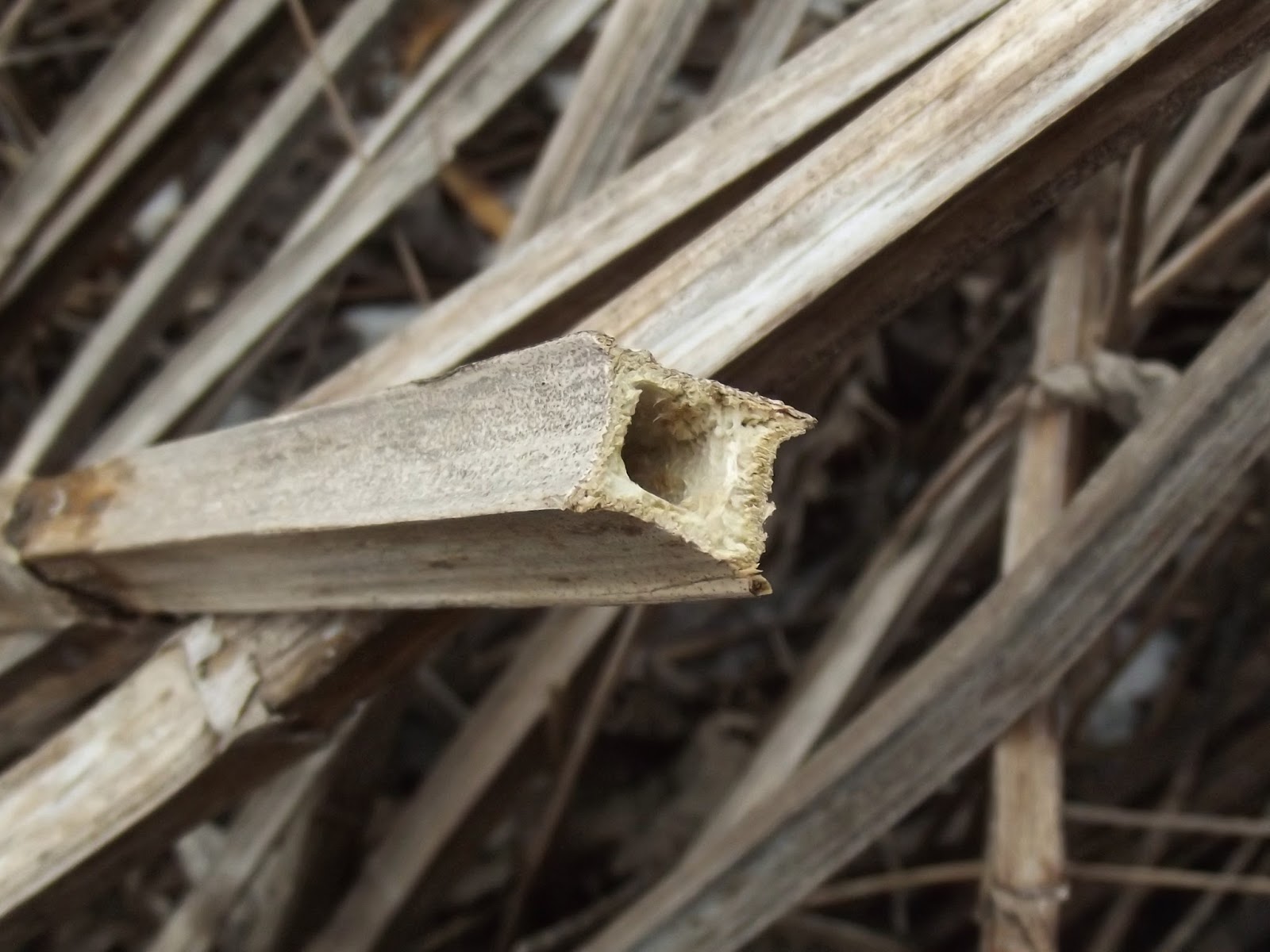
Distinguishing a "natural" hollow from a borer tunnel isn't always easy. In this case, I found that the borer tunnels could be identified by discoloration and especially by the presence of crumbly poop (frass):

Now cup-plant stems are pretty thick, and this tunnel is wide and crammed with LOTS of frass -- so I deduced that the borer must be pretty large (for a stem-dwelling insect). Of course, in this case the bird had found its prey, extricated it from its tunnel, and eaten it, so I was out of luck...but not for long. A neighboring stem was similarly tunneled, and the birds hadn't gotten to it yet -- and I was fortunate enough to open it up next, and find this inside:


How's THAT for a tasty bird-morsel?
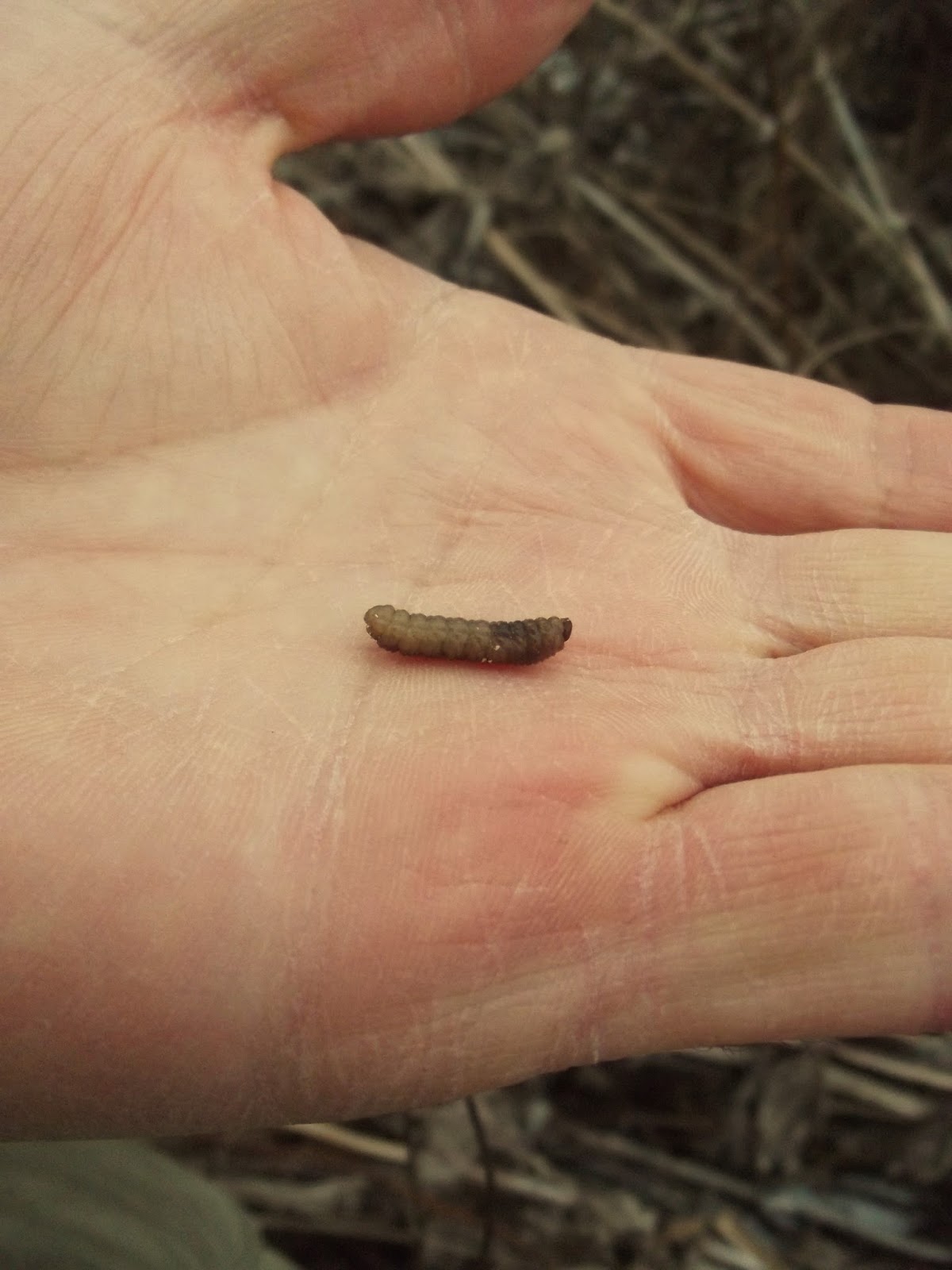
Judging by the slightly swollen thorax, well-defined head, and lack of obvious prolegs, I think this is a beetle larva, but I'm not sure. Its color seems "off" to me, suspicious, like the larva might be unwell...so I'm not particularly optimistic about getting an adult. But I did reintroduce it to a cup plant stem and bring it home for rearing. We'll see what happens.
After finding this, I spent a while hunting other nearby patches of cup-plant for bird-holes and borer tunnels. In the end I found only three or four stems that had clearly been pecked up by birds, and I wasn't able to find any more intact stems with borer larvae still inside. So it's not clear to me how widespread the bird sign or the insect prey may be. However, you can bet I'll be watching the next patch of cup-plant I come across -- and I hope you do too!
On my way back to the car, as darkness arrived, I scored one last insect sighting:

This is a stem gall on indigo bush (Amorpha fruticosa), a native shrub. In past visits to the Community Prairie, I'd looked for this gall to no avail -- so I was surprised and pleased to find it this time. If you cut it open you would find a sizable larva overwintering inside -- a moth larva, specifically, belonging to the genus Walshia. You can also find similar galls on indigo bush's congener, leadplant (Amorpha canescens). As with most other larval insects found in stems at this time of year, Walshia caterpillars will pupate sometime in the spring and emerge as adults shortly thereafter.
Incidentally, the foliage of indigo bush can be easily confused with that of black locust, a thorny tree that has been attempting to establish itself in the Community Prairie. Volunteers have spent a lot of time removing locust from this site -- and they are to be commended for recognizing indigo bush as a different (and less aggressive) plant and letting it be.
All for now!